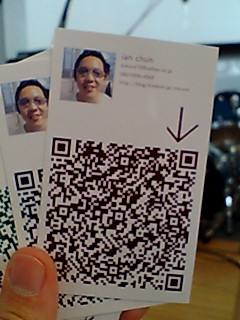
One thing that has become obvious as of late is that along with educating people about the mobile Internet, it’s necessary to also offer tools that provide easy access to it. This is especially true when it comes to helping people discover and connect with off-portal mobile content and services. Part of this requires finding solutions that are successful at making connections between the physical world and mobile Internet.
One of the tools which aim to converge “realspace” and “mobilespace” are bar codes (think of them as a form of physical hyperlink.) It works like this. Let’s say you’re walking along a sidewalk and someone hands you a flyer. Glancing down you notice a bar code placed neatly within the design. Immediately you take a photograph of the bar code with your mobile phone. Software on your phone converts the snapshot of the code into a mobile address. You are automatically offered the option to launch this address in the phone browser. Doing so launches your mobile browser and you are taken directly to the linked content — jumping you from printed content to online content.
You might be asking yourself about now, “Gee. I don’t know if people will actually do that?” Well the short answer is – people already do, lots of them in fact. In Japan, for example, QR codes have become part of everyday life, available on everything from business cards, id cards, magazines, newspapers, flyers, posters, stickers, food products,puzzles, web sites, billboards, more billboards, CDs, confectionary delights, calling a cab, vending machines, coffee cups, advertisements, and tickets –- even including the occasional booth-babe (my apologies to Darla Mack).  All these little codes eagerly await — ready to link people to content that matters to them — mobile sites, profiles, videos, podcasts, products and other little pieces of content (think ringtones and wallpapers). Individuals also have joined in on the opportunity as publishers themselves — printing codes on stickers, placing them on their web sites or blogs, even walking around with cute little stampers to easily affix codes practically anywhere for any reason. As such, QR Codes have become the door to the mobile Internet for the average mobile user.
Much like other mobile technology, such as SMS, it typically takes a while for the US market to embrace new mobile technology, but once it does we quickly match the usage seen in other parts of the world. I believe that will happen with bar codes as well. Already I see the signs…
For example, Semapedia.org brought to you by the brilliant minds of Stan Wiechers and Alexis Rondeau, are connecting the virtual and physical world by bringing the best information from the Internet to the relevant place in physical space. They do this by combining the physical annotation technology of Datamatrix codes (another flavor of bar code) with high quality information from Wikipedia. (see Semapedia explained with pictures)
Others like the creative team of Kevin Slavin and Frank Lantz from area/code turn city streets into huge public game boards using bar codes and cell phones as part of the game play.
Still not convinced people find this useful, fun or both? To highlight potential, I’ve provided results from a survey originally taken by InfoPlaint in Japan that was carried out at the end of August 2005. The respondents selected the survey themselves via a link in the DoCoMo iMode menu system. 7,660 people completed the survey; 5,023 of them were women.
Q: Do you know about QR codes (2D barcodes)?
- I’ve used them 73.3%
- I know about them, and have a reader feature in my phone, but I haven’t used them 7.6%
- I know about them, but don’t have a reader feature in my phone, so I haven’t used them 15.6%
I don’t know about them 3.5%
Looking at the age breakdown, for both males and females almost 90% of the under 20’s use them, but the rate steadily drops down to end up at just about half of all the over 50s.
Q: For those who answered that they used them, in what printed materials have you used QR Codes? (Sample size=5,513)
- Business card 5.7%
- Newspaper 31.9%
- Magazine 84.2%
- Advertising flyer 51.1%
- Poster 14.2%
- Direct mail 25.0%
- Mail-order catalog 24.8%
- PC web site 20.7%
- Other 13.1%
There was no significant differences between the sexes, except for almost two and a half times more women used mail-order catalog QR Codes.
Q: Which of the following QR Code-based services do you want to use? (Sample size=7,660)
- Easy phone book registration from a business card, etc 36.8%
- Read a URL and access a site 74.3%
- Replacement for company identification badge 29.0%
- Cashless shopping at vending machines, etc 28.3%
- Buying goods written about in magazines 27.7%
- Replacement for tickets (concerts, travel passes, etc) 32.5%
- Others 5.5%
- Don’t want to use 7.4%
Okay, so I’ve tried to do a bit of convincing but to what end? I see it this way, Winksite is the quickest way to build a mobile audience. Our RSS-driven publishing tools let you simply and easily add your information to the mobile Internet in ways that thrill mobile users. Thousands operate mobile spaces at Winksite with the added benefit of community features such chat, forums, and polls. We also want to help our publishers and their fans promote their space to mobile users. One way we do this is by aggregating our communities into a blog sidebar where mobile and desktop users find each other by interest and location.
Pulling It All Together
Another way is to help people promote their spaces in everyday situations and circumstances. Current camera phones now have good enough optics, resolution and processing power to be able to read these special bar codes on the printed materials we come across each day. As such, Winksite now provides a set of unique bar codes for each of our publishers that link directly to their mobile sites and communities. With the ability to create a universally accessible mobile site that’s connected to physically distributed bar codes, we see our publishers creating a wide range of useful applications.
These applications include:
- linking print articles to RSS feeds and blogs
- delivering product or tourist information
- linking “lost pet” flyers to contact forms
- dating – use your imagination on that one
- “find me” maps
- promoting an event or concert on flyers/postcards
- connecting geocachers to mobile logbooks
- creating museum exhibits and street tours
- building scavenger hunts or “collect-them-all” games
- downloading ringtones, music, wallpapers or video (think indie artists)
- ticket sales for clubs
- directing people to your mobile site and/or storefront
- enabling mobile sales from catalogs or flyers
- distributing coupons
- conference badges connected to profiles
- business cards connected to company sites
- signing up to text alert services
- running competitions
- connecting mix tapes to podcasts or vidcasts
- connecting posters to podcasts or vidcasts
- enabling community interaction at public locations
As the World Wide Web showed, things really take off when users build out their own real estate. The success of the Web was partly a result of the distributed development of local content and economies driven by individual passion. It’s happening all over again on the mobile web. Be a part of it.
Please Note: “Booth-Babe” photo provided by news.3yen.com.

 harper.wirelessink.com