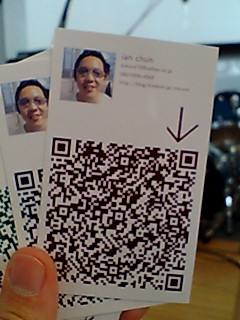
CTIA Release: More Mobile Bar Code Love

This this the first of several releases concerning WINKsite, our efforts to move mobile bar coding forward in the U.S., and the partners we’re doing it with.

NEXTCODE INTEGRATES CAMERA PHONE CODE SCANNING SERVICE FOR WINKSITE

ConnexTo™ service improves content access and merchandising for leading mobile content site.

Las Vegas, NV., April 5, 2006 – – Nextcode Corporation (www.nextcodecorp.com), a leader in optical barcode reading solutions for camera phones, today announced that Wireless Ink Corp has integrated its ConnexTo code creation and code reading capabilities into its WINKsite Mobile Community. With this partnership, WINKsite publishers will be able to create 2D codes that can be scanned with camera phones to provide one-click direct access to the mobile sites. Publishers can now easily incorporate codes into print or on-screen promotional materials to drive increased traffic to the mobile content.

The ConnexTo Code Creation tools can be integrated with mobile content systems, such as WINKSite, allowing publishers to embed web addresses into codes. Consumers can install the free ConnexTo Code Reader onto standard camera phones to easily link
to Web content and to enable a range of mobile applications. ConnexTo uses a new two-dimensional (2D) code format called mCode™ specifically designed for camera phones and mobile services. Free personal code-creation tools and information on downloading the free code reader software is available at http://www.ConnexTo.com.

WINKsite powers over 13,000 publishers including brands such as FUSE TV, O’Reilly’s MAKE: Magazine, and Warner Bros Records. Each responded to WINKsite’s benefits during the last 18 months by creating direct-to-consumer portals and communities. These spaces are generating over 20 million mobile screen impressions per month. Sites are created specifically for mobile use and include such things as blogs, journals, chat rooms and forums. Free personal site-creation tools are available at http://www.WINKsite.com.

“We are very happy to be teaming with WINKsite. They make it simple for publishers to create and publish mobile content. With ConnexTo, we are helping their publishers promote their content by make it easy to get to these sites,” said Jim Levinger, CEO of Nextcode. “Instead of requiring dozens of keystrokes, now with ConnexTo, users can simply point, click and enjoy.”

“The amount of content available on the wireless web is growing very fast. But given the constraints of the phone UI, it is often tough to navigate to it,” said Dave Harper, founder of Wireless Ink. “As such, we have been eager to integrate a code scanning solution for our publishers so that their audiences can get to the content that matters to them quickly. We are very impressed by the Nextcode solution. We have found it to be powerful, flexible and very easy to use.”

One example of how ConnexTo improves the wireless experience is in the case of street marketing. A band can distribute posters advertising an upcoming show with a mCode printed on it. Instead of having to search for a pen and paper to write the time and place, or go through the tedious process of keying it into the phone, fans simply take a picture of the mCode to store that information or link directly to it.

ABOUT NEXTCODE
Nextcode is a leader in optical barcode scanning technology and was founded in 2003 in Concord, Mass. The company’s goal is to simplify mobile services and remove usability barriers to accessing mobile content, commerce and services. For more information, visit http://www.nextcodecorp.com.

ConnexTo and mCode are trademarks of Nextcode Corporation.

ABOUT WIRELESS INK
Wireless Ink is a leading mobile content management and social networking software company whose solutions connect publishers to their audiences and audience members to each other on mobile phones. Whether you’re an individual, a brand or a community, Wireless Ink (WINKsite) provides a powerful one-stop solution for creating, managing and aggregating mobile communities. For more information visit http://www.winksite.com/.

"Bling For Your Blog"

Something we’re thrilled to be a part of:

Six Apart Launches Open Widget Platform for TypePad Blogs; Thirty-Two Companies Among the First to Extend TypePad With Widgets That Add Power to the Award-Winning Blogging Service

SAN FRANCISCO–(BUSINESS WIRE)–March 30, 2006–Six Apart, the world leader in blogging software and services for individuals and businesses, today launched a new, open widget initiative to expand choice and functionality for TypePad subscribers and readers. Thirty-three widgets are ready today that put new interactive features into blogs, such as job searching, game playing, weather tracking, and photo sharing. Widget installation is a snap, taking no more than a few clicks. A complete widget directory is available at http://www.sixapart.com/typepad/widgets.

Mainstream America is Ready for Bar Codes – Converging "Realspace" and "Mobilespace"

One thing that has become obvious as of late is that along with educating people about the mobile Internet, it’s necessary to also offer tools that provide easy access to it. This is especially true when it comes to helping people discover and connect with off-portal mobile content and services. Part of this requires finding solutions that are successful at making connections between the physical world and mobile Internet.

One of the tools which aim to converge “realspace” and “mobilespace” are bar codes (think of them as a form of physical hyperlink.) It works like this. Let’s say you’re walking along a sidewalk and someone hands you a flyer. Glancing down you notice a bar code placed neatly within the design. Immediately you take a photograph of the bar code with your mobile phone. Software on your phone converts the snapshot of the code into a mobile address. You are automatically offered the option to launch this address in the phone browser. Doing so launches your mobile browser and you are taken directly to the linked content — jumping you from printed content to online content.

You might be asking yourself about now, “Gee. I don’t know if people will actually do that?” Well the short answer is – people already do, lots of them in fact. In Japan, for example, QR codes have become part of everyday life, available on everything from business cards, id cards, magazines, newspapers, flyers, posters, stickers, food products,puzzles, web sites, billboards, more billboards, CDs, confectionary delights, calling a cab, vending machines, coffee cups, advertisements, and tickets –- even including the occasional booth-babe (my apologies to Darla Mack). All these little codes eagerly await — ready to link people to content that matters to them — mobile sites, profiles, videos, podcasts, products and other little pieces of content (think ringtones and wallpapers). Individuals also have joined in on the opportunity as publishers themselves — printing codes on stickers, placing them on their web sites or blogs, even walking around with cute little stampers to easily affix codes practically anywhere for any reason. As such, QR Codes have become the door to the mobile Internet for the average mobile user.

Much like other mobile technology, such as SMS, it typically takes a while for the US market to embrace new mobile technology, but once it does we quickly match the usage seen in other parts of the world. I believe that will happen with bar codes as well. Already I see the signs…

For example, Semapedia.org brought to you by the brilliant minds of Stan Wiechers and Alexis Rondeau, are connecting the virtual and physical world by bringing the best information from the Internet to the relevant place in physical space. They do this by combining the physical annotation technology of Datamatrix codes (another flavor of bar code) with high quality information from Wikipedia. (see Semapedia explained with pictures)

Others like the creative team of Kevin Slavin and Frank Lantz from area/code turn city streets into huge public game boards using bar codes and cell phones as part of the game play.

Still not convinced people find this useful, fun or both? To highlight potential, I’ve provided results from a survey originally taken by InfoPlaint in Japan that was carried out at the end of August 2005. The respondents selected the survey themselves via a link in the DoCoMo iMode menu system. 7,660 people completed the survey; 5,023 of them were women.

Q: Do you know about QR codes (2D barcodes)?

  • I’ve used them 73.3%
  • I know about them, and have a reader feature in my phone, but I haven’t used them 7.6%
  • I know about them, but don’t have a reader feature in my phone, so I haven’t used them 15.6%
    I don’t know about them 3.5%

Looking at the age breakdown, for both males and females almost 90% of the under 20’s use them, but the rate steadily drops down to end up at just about half of all the over 50s.

Q: For those who answered that they used them, in what printed materials have you used QR Codes? (Sample size=5,513)

  • Business card 5.7%
  • Newspaper 31.9%
  • Magazine 84.2%
  • Advertising flyer 51.1%
  • Poster 14.2%
  • Direct mail 25.0%
  • Mail-order catalog 24.8%
  • PC web site 20.7%
  • Other 13.1%

There was no significant differences between the sexes, except for almost two and a half times more women used mail-order catalog QR Codes.

Q: Which of the following QR Code-based services do you want to use? (Sample size=7,660)

  • Easy phone book registration from a business card, etc 36.8%
  • Read a URL and access a site 74.3%
  • Replacement for company identification badge 29.0%
  • Cashless shopping at vending machines, etc 28.3%
  • Buying goods written about in magazines 27.7%
  • Replacement for tickets (concerts, travel passes, etc) 32.5%
  • Others 5.5%
  • Don’t want to use 7.4%

Okay, so I’ve tried to do a bit of convincing but to what end? I see it this way, Winksite is the quickest way to build a mobile audience. Our RSS-driven publishing tools let you simply and easily add your information to the mobile Internet in ways that thrill mobile users. Thousands operate mobile spaces at Winksite with the added benefit of community features such chat, forums, and polls. We also want to help our publishers and their fans promote their space to mobile users. One way we do this is by aggregating our communities into a blog sidebar where mobile and desktop users find each other by interest and location.

Pulling It All Together
Another way is to help people promote their spaces in everyday situations and circumstances. Current camera phones now have good enough optics, resolution and processing power to be able to read these special bar codes on the printed materials we come across each day. As such, Winksite now provides a set of unique bar codes for each of our publishers that link directly to their mobile sites and communities. With the ability to create a universally accessible mobile site that’s connected to physically distributed bar codes, we see our publishers creating a wide range of useful applications.

These applications include:

  • linking print articles to RSS feeds and blogs
  • delivering product or tourist information
  • linking “lost pet” flyers to contact forms
  • dating – use your imagination on that one
  • “find me” maps
  • promoting an event or concert on flyers/postcards
  • connecting geocachers to mobile logbooks
  • creating museum exhibits and street tours
  • building scavenger hunts or “collect-them-all” games
  • downloading ringtones, music, wallpapers or video (think indie artists)
  • ticket sales for clubs
  • directing people to your mobile site and/or storefront
  • enabling mobile sales from catalogs or flyers
  • distributing coupons
  • conference badges connected to profiles
  • business cards connected to company sites
  • signing up to text alert services
  • running competitions
  • connecting mix tapes to podcasts or vidcasts
  • connecting posters to podcasts or vidcasts
  • enabling community interaction at public locations

As the World Wide Web showed, things really take off when users build out their own real estate. The success of the Web was partly a result of the distributed development of local content and economies driven by individual passion. It’s happening all over again on the mobile web. Be a part of it.

Please Note: “Booth-Babe” photo provided by news.3yen.com.

How to Free Yourself From Google's Mobile Transcoding Services in 5 Days or More.

The other day I wrote about Google’s mobile transcoding services and the reasons for our issues with it in a post titled, “An Open Letter to Google: “Page adapted for mobile phone?” Please stop now, you are crippling sites, not adapting pages.

The lack of clarity as to how the transcoding services worked and how you could opt-out was frustrating. In our case, Google’s transcoding service was doing more harm then good. Naturally we “Googled” Google and eventually found a mobile FAQ that stated:

Our system automatically translates regular pages into wap-compatible [i.e. mobile] pages. In cases where a wap-compatible site already exists, we redirect the user to the wap-compatible site instead of translating the page ourselves.

We found that not to be the case. In Scott Rafer’s words:

To use WINKsite as a specific example, Google Mobile Search ignores the mobile site that took our founders years of hard work and which is now a global mobile community used by tens of thousands of people every day. Instead, Google Mobile Search uses our standard web homepage, rips it apart, and sends it to people’s mobile phones as 15 crappy pages of unintelligible garbage.

Reading back through the FAQ later we discovered that Google did in fact provide a method for web site publishers to be excluded from Google Mobile’s re-rendering by sending a “removal request” by email to mobile-support@google.com. Accordingly we sent this email to Google on 3/12/2006 11:16 PM:

Please remove transcoded pages for http://winksite.com (re: http://www.google.com/webmasters/remove.html#transcoded)

Thank you.
Dave Harper
Founder, Wireless Ink/WINKsite

On 3/12/2006 11:16 PM we received the following response:

Thank you for your note. This is just an automated reply to let you know that we received your email. We’re currently putting most of our energy into improving Google Mobile, so we can’t promise a personal reply to every question. Please be assured that your feedback will be used to improve Google Mobile. For a quick answer, you may want to visit our FAQ at http://www.google.com/mobile/faq.html

Regards,
The Google Team

Followed the next morning (3/13/2006 11:46 AM) with:

Hi Dave,

Thank you for your note. As requested, your page will no longer be transcoded to a mobile-ready format.

We’re constantly working to improve the way pages are displayed on mobile web browsers. If you have any suggestions, please let us know.

Regards,
The Google Team

Well nothing changed, our audience was still blocked from our mobile site, and a debate which originally started at MobHappy continued here, here, here, and here.

Finally on the morning of 3/17/2006 I awoke to discover that after 5 days of jumping up and down on blogs all over the blogosphere — WINKsite had been set free. “Being Free” is good.

…but what about others in the same fix.

The process and exclusion list doesn’t seem like a good permanent solution (and it’s not just Google that’s handling mobile wrong.) What’s needed is a way to respect the rights of mobile publishers and their audience without making them jump through hoops. The conversation has started. Hopefully the dialogue leads towards a better understanding of the mobile web.

Count us in.

Update: Received 3/17/2006 8:19 PM

Hi Dave,

We just wanted to let you know that your site is no longer being transcoded. We apologize for any inconvenience this may have caused.

If we can assist you further, please let us know.

Regards,
The Google Team

An Open Letter to Google: “Page adapted for mobile phone?” Please stop now, you are crippling sites, not adapting pages.

Dear Google,

I just used Google on various mobile devices (i.e. a Nokia 6600, Sony w800, and Motorola RAZR V3) to search for my service Winksite.com. Rather than link to Winksite directly the results instead link to a reformatted version that in Google’s words is “adapted for mobile phone”.

You’re assuming way too much power in hijacking Winksite and replacing it with your own version. The 15-screen, bastardized version of the site that you deliver is not even close to what WE want to deliver or what our audience expects to receive. Let me explain.

From my perspective, the issue is not that Google unilaterally strips away eye candy only to deliver a hodgepodge of text on mobile devices. It is that you remove user access to mobile-specific services on which ours and many other businesses are based. By default, your actions censor those of us who provide a unique and/or useful mobile experience.

The mobile web and its proponents were in place for years before Google “discovered” the mobile web and started to hijack it. Individuals, small development teams, and companies that respect and value the mobile audience provide mobile sites and services designed for that audience. With a bit of browser detection, Winksite and others send these visitors to either mobile optimized versions of their sites or even mobile phone-specific services. Google mobile web search intercepts and overrides that detection, context, and delivery. I question your right to do that and without permission to create a derivative work. (At Mobhappy Google’s tactics are questioned for other reasons – Who Gave Google Permission to be the Judge and Jury of Mobile Content?.)

Google’s actions cripple every truly mobile web site that its search uncovers, violating the copyright of each and reducing all of them to a lowest common denominator that sets the mobile web back ten years. “Do No Evil” requires that you stop now.

Dave Harper
Founder, Wireless Ink

P.S.
Scott continues the conversation with “Garbage 2.0 In, Garbage 2.0 Out“.

About David Harper

David founded Wireless Ink aka Winksite (http://winksite.com) a leading mobile content management and social networking software company whose solutions connect publishers to their audiences and audience members to each other. It is his belief that the availability of simple tools that enable direct-to-audience publishing and community across all devices and networks is essential to “ripping mobility from the clutches of telecom” (tag borrowed from Mike Rowehl, MoMo Silicon Valley.)

David has more then 20 years experience as an entrepreneur, technologist, and senior level executive. During this time Mr. Harper successfully founded several software development companies, one of which he sold to an investment bank after growing it from scratch to millions in revenues. David has also been instrumental in capital raises and P&L for companies under management. His forward-thinking expertise in information architecture, UI design and content publishing has provided award-winning solutions for established major brands. His clients have included: Cablevision, FUSE TV, adidas, Computer Associates, Comverse, Verint, Schering Plough Key, Nickelodeon, Time Warner, RIA Group, Nortel and Heidelberg Publishing Group — among others.

Born in the USA, lived in London SW5 during the birth of punk. David is now a hardcore member of the mobile revolution – connecting the world from the streets. David Harper’s Blog “Different Things” can be found at http://harper.wirelessink.com.

Upcoming.org Understands The Value Of "Mobile-Friendly"

Feeds have evolved into a popular means of sharing content between sites and are now going mainstream as more people become aware of the benefits. The use of feeds to syndicate content to mobile devices is also increasing — placing a much needed focus on the quality and usefulness of the information contained in those feeds.

Case in point are event feeds. While greatly useful from the desktop, they usually fail from the mobiles user’s perspective because 1) the feed requires you to link off to content that is not optimized for mobile devices or 2) critical information is missing from the feed — either way the mobile experience becomes a dead end.

Thanks to Andy and Gordon over at Upcoming, WINKsite is now able to go beyond the limits of basic event feed publishing to deliver a more relevant, more precise means of mobile event distribution and device independent delivery.

Let me explain, while mobilizing the Metroblogging Network’s blog and event feeds we connected with the Upcoming team. We explained to them the challenges to mobile users as we understand them to be as well as our thoughts as to how the mobile experience could be improved. They listened.

After several emails passing ideas and specs back and forth, Upcoming modified their feeds with mobile users in mind (within 24 hours mind you.) Each Upcoming feed now contains additional information such as an event’s start date/time, venue name, location, and phone number (utilizing xCal extensions.) In addition, various URL parameters are now available providing various sorting and count options. Using these extensions, Winksite was able to intelligently display various event information in our mobile UI as well as make those data (phone numbers for example) actionable. The mobile goodness doesn’t end there. These feed additions also will allow us to build other web services around these data. For example, Upcoming event feeds with Yahoo! Weather, Yahoo! Traffic, and direction feeds/APIs can now be mashed up to support a more useful and productive mobile experience.

More soon on additional ways Winksite is working with partners to make feeds “Mobile-Friendly.”

One World. No Borders. : Metroblogging Network “Mobilized” By Winksite Across 42 Cities

Winksite has helped Metroblogging go mobile across their network of 42 cities. We’re excited to be working with Sean, Jason and the rest of the Metroblogging Team.

Special thanks to Andy and Gordon over at Upcoming for adding some new tricks to their event feeds. With their help we were able to provide some additional mobile goodness for the Metroblogging Community (more on that in my next post.)

Just fire up a mobile browser and head over to http://cityname.metblogs.com/mobile/ and check it out on your phone.

Alternatively, select one of the metro links below to view it’s mobile site from our desktop emulator.

Metroblogging Atlanta
Metroblogging Austin
Metroblogging Bangalore
Metroblogging Bangkok
Metroblogging Berlin
Metroblogging Burmingham
Metroblogging Boston
Metroblogging Cayman
Metroblogging Chicago
Metroblogging Dallas
Metroblogging Denver
Metroblogging Detroit
Metroblogging Dubai
Metroblogging Dublin
Metroblogging Hawaii
Metroblogging Houston
Metroblogging Islamabad
Metroblogging Instanbul
Metroblogging Karachi
Metroblogging Lahore
Metroblogging London
Metroblogging Los Angeles
Metroblogging Manila
Metroblogging Melbourne
Metroblogging Miami
Metroblogging Minneapolis
Metroblogging Montreal
Metroblogging Mumbai
Metroblogging New Orleans
Metroblogging New York City
Metroblogging Orlando
Metroblogging Paris
Metroblogging Philadelphia
Metroblogging Phoenix
Metroblogging Portland
Metroblogging San Francisco
Metroblogging Orange County
Metroblogging Seattle
Metroblogging Singapore
Metroblogging Tokyo
Metroblogging Toronto
Metroblogging Vancouver
Metroblogging Vienna
Metroblogging Washington D.C.

Everyware : The Dawning Age of Ubiquitous Computing

Adam Greenfield’s book “Everyware : The Dawning Age of Ubiquitous Computing” is about to be released.

I’ve known Adam for a number of years (he was an early advisor of mine while WINKsite was being conceived), enjoying many engaging conversations over many a cup of coffee. “Everyware” is the culmination of his life experiences, thoughtful explorations, and beliefs. I for one can not wait to get my hands on my pre- ordered copy.

Last year, Adam Greenfield wrote an inspring article titled, “All watched over by machines of loving grace: Some ethical guidelines for user experience in ubiquitous-computing settings”. (On the same topic.)

Adam provided some general principles for us to observe, as designers and developers for ubiquitous systems.

    Principle 0, is, of course, first, do no harm.

    Principle 1. Default to harmlessness. Ubiquitous systems must default to a mode that ensures their users’ (physical, psychic and financial) safety.

    Principle 2. Be self-disclosing. Ubiquitous systems must contain provisions for immediate and transparent querying of their ownership, use, capabilities, etc., such that human beings encountering them are empowered to make informed decisions regarding exposure to same.

    Principle 3. Be conservative of face. Ubiquitous systems are always already social systems, and must contain provisions such that wherever possible they not unnecessarily embarrass, humiliate, or shame their users.

    Principle 4. Be conservative of time. Ubiquitous systems must not introduce undue complications into ordinary operations.

    Principle 5. Be deniable. Ubiquitous systems must offer users the ability to opt out, always and at any point.

I, for one, am sticking close and watching Adam. You should, too.

Book Description: Everyware : The Dawning Age of Ubiquitous Computing
“From the RFID tags now embedded in everything from soda cans to the family pet, to smart buildings that subtly adapt to the changing flow of visitors, to gestural interfaces like the ones seen in Minority Report, computing no longer looks much like it used to. Increasingly invisible but present everywhere in our lives, it has moved off the desktop and out into everyday life–affecting almost every one of us, whether we’re entirely aware of it or not.

Author Adam Greenfield calls this ubiquitous computing “everyware.” In a uniquely engaging approach to this complex topic, Greenfield explains how such “information processing dissolving in behavior” is reshaping our lives; brief, aphoristic chapters explore the technologies, practices, and innovations that make everyware so powerful and seem so inevitable.

If you’ve ever sensed both the promise of the next computing, and the challenges it represents for all of us, this is the book for you. “Everyware” aims to gives its reader the tools to understand the next computing, and make the kind of wise decisions that will shape its emergence in ways that support the best that is in us.”

Adam Greenfield
(From Wikipedia, the free encyclopedia.)

Adam Greenfield is an American writer and information architect. He was born in Philadelphia, Pennsylvania in 1968.

Greenfield attended New York University during the late 1980s, earning a degree in Cultural Studies. By the mid-1990s, he had enlisted in the United States Army’s reserve component Special Operations Command as a Psychological operations specialist, holding MOS 37F and eventually achieving the grade of Sergeant.

Greenfield took up work in the then-nascent field of information architecture for the World Wide Web, holding a succession of prominent positions culminating in employment at the Tokyo office of Razorfish, where he was head of the information architecture department. He is probably best known for having written an “open-source constitution for post-national states” called the Minimal Compact, as well as proposed ethical guidelines for developers of ubiquitous-computing environments. He is also credited with having coined the word “moblog” to describe the practice of publishing to the World Wide Web from mobile devices, and the word “everyware” as an umbrella term for ubiquitous and pervasive computing, ambient informatics and tangible media. He is the author of Everyware: The Dawning Age of Ubiquitous Computing (ISBN 0321384016) (2006).

He is generally considered to be a thought leader in the information architecture and user experience professions. Greenfield maintains a Web site devoted to discussions of “beauty, utility and balance across the meta-field of design.”